EMAT Thickness Gauges
Revolutionary electromagnetic acoustic transducer technology for non-contact ultrasonic thickness measurement. Perfect for high-temperature applications and surfaces with coatings.
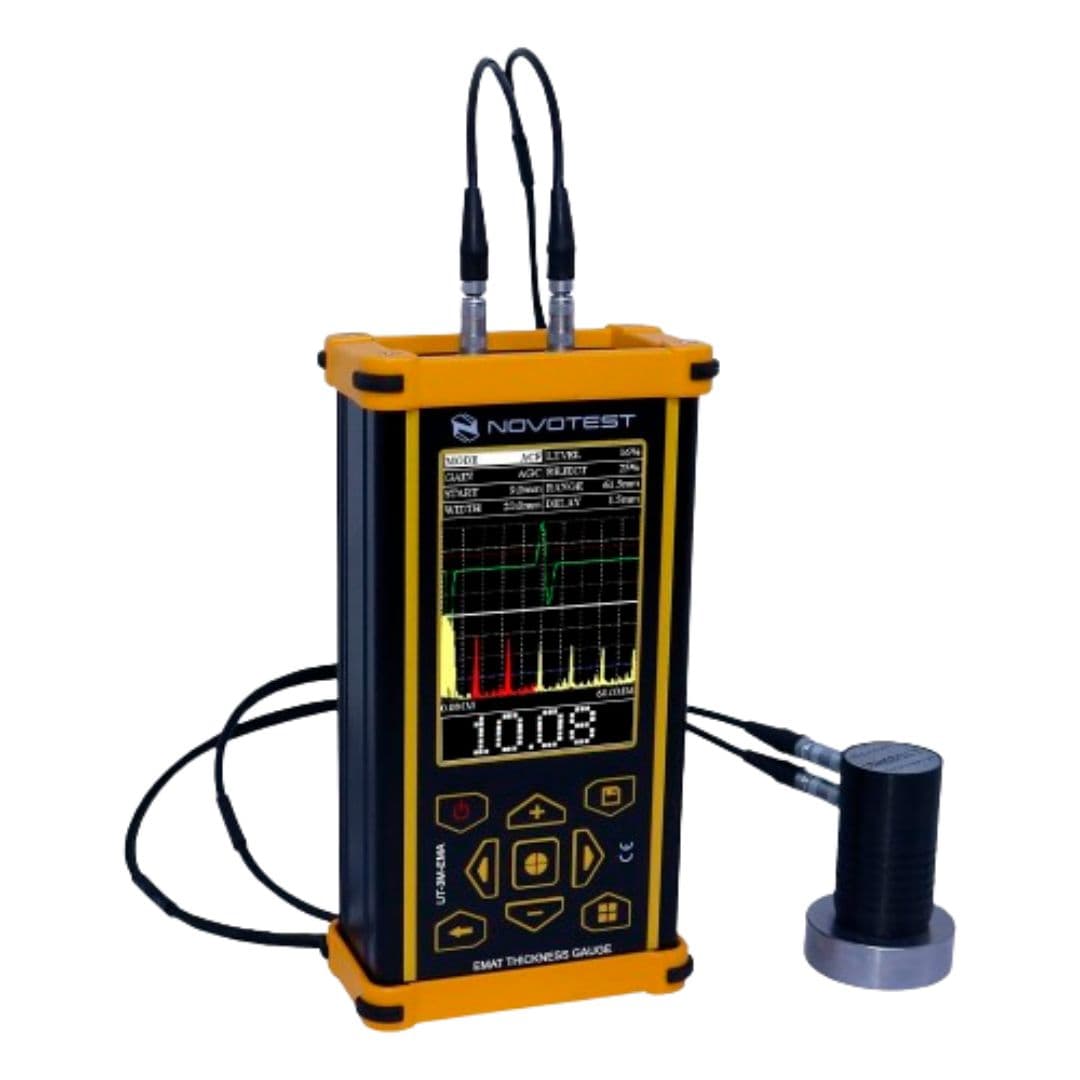
EMAT Thickness Gauge
Electromagnetic acoustic transducer for thickness measurement
- The thickness gauge boasts a unique automatic mode that sets it apart from competitors. The mode that makes it easy for anyone to measure metal thickness quickly and accurately. The instrument automatically analyzes the signal selects the correct measurement method and adjusts the settings. Users see the thickness result displayed in large numbers.
- The gauge also features a B-scan mode. This mode gives users a visual profile of the product like a picture making it easy to read. Using a special probe cart users can scan larger objects and obtain a detailed thickness profile.
- To sort products based on set thickness limits the gauge offers a special control mode. Simply set the minimum and maximum thickness values and get a graphical display of the results. An alarm sounds if the measured thickness falls outside of these limits. This mode also helps evaluate corrosion damage as a percentage of the product’s original thickness.
- For expert testing operators can manually measure thickness using a variety of methods such as the autocorrelation function (ACF) measuring between two peaks in a gate zero-crossing and echo methods.
About this category
Revolutionary electromagnetic acoustic transducer technology for non-contact ultrasonic thickness measurement. Perfect for high-temperature applications and surfaces with coatings.
EMAT Technology Advantages
No Couplant Required
EMAT technology eliminates the need for liquid couplant, making measurements faster and cleaner, especially on vertical or overhead surfaces.
High Temperature Capability
Measure thickness on surfaces up to 500°C without cooling, ideal for online monitoring in industrial processes.
Through Coating Measurement
Accurately measure base material thickness through paint, rust, or other coatings without surface preparation.
Non-Contact Operation
Small air gap between transducer and surface allows measurement without physical contact, reducing wear and contamination.